Achim Jung’s category of FS-domains is one of the two maximal cartesian-closed categories of continuous dcpos [1], and their theory is proposed as Exercises 9.6.25—9.6.32 in the book. Recently, Wei Luan proposed a variation on the notion, and which he calls ≪-separating domains. One of his main theorems is that given an FS-domain X and a ≪-separating domain Y, the space of Scott-continuous maps [X → Y] is a ≪-separating domain. Another one is that the same holds if instead X is assumed to be Noetherian; in passing, he proves an interesting lemma on the way-below relation on spaces of Scott-continuous maps—this will be Lemma C below. Unfortunately, we will see that the category of ≪-separating domains is not Cartesian-closed, but that is life.
RB-domains, FS-domains, ≪-separating domains
Using the denomination used by Wei Luan, FS-domains are defined through the help of something called an approximate identity. (I didn’t define the notion in the book, though, but this is practical.) An approximate identity on a dcpo X is a directed family of Scott-continuous maps (fi)i ∈ I from X to X such that the pointwise supremum supi ∈ I fi is equal to the identity map on X.
An RB-domain is a dcpo with an approximate identity (fi)i ∈ I consisting of deflations; namely, each fi (is ≤ idX and) has finite image. Every RB-domain is a continuous dcpo, is stably compact in its Scott topology (Theorem 9.6.22 in the book), and the category RB of RB-domains is Cartesian-closed (Theorem 9.6.24 in the book). The prefix “RB” means “retract of bifinite”, and this refers to their actual definition: as retracts of bifinite domains, but this will not be important here.
My preferred Cartesian-closed category of continuous dcpos, as far as semantics of programming languages is concerned, is the category BCDom of bc-domains. The prefix “bc” stands for “bounded-complete”, but, following Prakash Panangaden, it is tempting to imagine that it means “bloody convenient”. Unfortunately, bc-domains lack a few occasional closure properties. The Plotkin powerdomain of a bc-domain is not a bc-domain in general, for example. The Plotkin powerdomain of an RB-domain is an RB-domain (I will not attempt to justify this here, and we will slowly forget about the Plotkin powerdomain in the rest of this post), though, and every bc-domain is an RB-domain (Exercise 9.6.20 in the book).
FS-domains form an even larger Cartesian-closed category FS of continuous dcpos, although we still do not know whether it is strictly larger than the category of RB-domains to this day.
A dcpo X is an FS-domain if and only if it has an approximate identity (fi)i ∈ I of functions that are finitely separated from the identity: namely, for each i ∈ I, there is a finite set Mi of points of X such that for every x ∈ X, there is a point m ∈ Mi that sits between fi(x) and x (fi(x) ≤ m ≤ x). In that case, we will say that Mi is a finite separating set for fi.
In general, if f is a Scott-continuous map from X to X with a finite separating set M, then f ≤ idX and for every x ∈ X, f(x) ≪ x, where ≪ is the way-below relation on X.
Definition. The ≪-separating domains that Wei Luan introduces are defined as those dcpos X with an approximate identity (fi)i ∈ I of functions such that for every x ∈ X, fi(x) ≪ x.
Hence every FS-domain is a ≪-separating domain.
It is also clear that every ≪-separating domain is a continuous dcpo: every point x is the supremum of a directed family of points way-below x, namely (fi(x))i ∈ I.
As a sanity check, we verify that the notion of ≪-separating domain is not vacuous. First, not every continuous domain is a ≪-separating domain: Plotkin’s tie (see Example 9.6.18 and Figure 9.4 in the book) is an example of a continuous dcpo, in fact even an algebraic dcpo, that is not a ≪-separating domain. I will omit the argument, which can be found at the end of Section 3 of [2].
Second, not every ≪-separating domain is an FS-domain. The example provided by W. Luan [2, Example 3.7] is as follows.
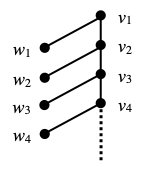
Example 0 (an algebraic ≪-separating domain that is not an FS-domain). Let Xcomb be the dcpo pictured above. Its elements are infinitely many, pairwise distinct elements vn and wn, where n ranges over N. The ordering is defined by:
- vm ≤ vn if and only if m≥n;
- vm ≤ wn never;
- wm ≤ vn if and only if m≥n;
- wm ≤ wn if and only if m=n; in other words, the elements wn are pairwise incomparable.
Xcomb is a dcpo because every directed family must in fact contain a largest element. It follows that every element of Xcomb is finite, hence Xcomb is algebraic. It also follows that every monotonic function from Xcomb to any poset is automatically Scott-continuous. Let I be the one element set {*}. We let fi : Xcomb → Xcomb be the identity map for every i ∈ I; in other words, f* = id. The family (f*)* ∈ I is trivially an approximate identity, and we have f*(x) ≪ x for every x ∈ X, since every point of X is finite, namely way-below itself. Therefore Xcomb is a ≪-separating domain.
We claim that Xcomb is not an FS-domain. Let us assume it is. Since it is algebraic, it must be a bifinite domain, by Exercise 9.6.30 in the book. In other words, there must be an approximate identity consisting of idempotent deflations. But there are no idempotent deflations on Xcomb. Indeed, let us imagine there is an idempotent deflation f on Xcomb. In other words, f o f = f, f ≤ id, and f has finite image. In particular, there are only finitely many points vn and finitely many points wn in the image of f. Let n0 ∈ N be such that every vn and every wn in the image of f is such that n<n0. Then f(vn0) ≤ vn0, so f(vn0) must be of the form vn or wn with n≥n0… hence not in the image of f, which is absurd. ☐
Since FS is a maximal Cartesian-closed category of continuous dcpos and since the category ≪S of ≪-separating domains is a larger category of continuous dcpos, we have the following alternative: either ≪S is not Cartesian-closed or ≪S=FS. We have just seen that the second term of the alternative is wrong. Therefore:
Fact. The category ≪S of ≪-separating domains is not Cartesian-closed.
Too bad.
The main theorem
The following is the first half of Theorem 4.1 of [2]. We have already announced it. In a sense, this shows how close ≪S is from being Cartesian-closed.
Theorem A. Given an FS-domain X and a ≪-separating domain Y, the space of Scott-continuous maps [X → Y] is a ≪-separating domain.
Proof. Let (fi)i ∈ I be a finitely separating approximate identity on X, and let Mi be a finite separating set for each i ∈ I. This means that for every x ∈ X, there is an element m of Mi such that fi(x) ≤ m ≤ x.
Let (gj)j ∈ J be an approximate identity on Y such that gj(y) ≪ y for every y ∈ Y.
We claim that:
For every Scott-continuous map h : X → Y, for all i ∈ I and j ∈ J,
gj o h o fi is way-below h in [X → Y].
(Please mind that I really mean “gj o h o fi is way-below h“, not “(gj o h o fi) (x) is way-below h (x) for every x ∈ X: that would be different.)
In order to see this, let (hk)k ∈ K be a directed family in [X → Y] such that h ≤ supk ∈ K hk.
- For every m ∈ Mi, gj(h(m)) ≪ h(m) ≤ supk ∈ K hk(m), so there is a index km in K such that gj(h(m)) ≤ hkm(m). Since Mi is finite and (hk)k ∈ K is directed, there is a common index k in K such that gj(h(m)) ≤ hk(m) for every m ∈ Mi.
- For every x ∈ X, let m ∈ Mi be such that fi(x) ≤ m ≤ x. Then (gj o h o fi) (x) ≤ gj(h(m)) ≤ hk(m) ≤ hk(x). We have just shown that gj o h o fi ≤ hk. Therefore gj o h o fi is way-below h in [X → Y].
(Note: the argument in the proof of this claim inside the proof of Theorem 4.1 of [2] is made a bit complicated by the introduction of a set Hy, in my opinion. Additionally, Hy is defined as ↑y ∩ δ−1(↓y), where δ is what I write as fi; but one should read ↓y ∩ δ−1(↑y) instead.)
Let Fij : [X → Y] → [X → Y] map every h ∈ [X → Y] to gj o h o fi. We have just shown that Fij(h) ≪ h for every h ∈ [X → Y]. It remains to show that (Fij)i ∈ I, j ∈ J is an approximate identity.
- The family (Fij)i ∈ I, j ∈ J is non-empty, and given any two of its elements Fij and Fi’j’, we can pick i” in I so that fi, fi’ ≤ fi” and j” in J so that gj, gj’ ≤ gj”. Then gj o h o fi and gj’ o h o fi’ are both below gj” o h o fi” for every h ∈ [X → Y], so Fij and Fi’j’ are both below Fi”j”. Hence (Fij)i ∈ I, j ∈ J is directed.
- For every h ∈ [X → Y], for every x ∈ X, supi ∈ I, j ∈ J Fij (h) maps x to supj ∈ J supi ∈ I (gj o h o fi) (x) = supj ∈ J (gj o h) (supi ∈ I fi(x)) (since gj o h is Scott-continuous) = supj ∈ J (gj o h) (x) = h(x), where we have used that (fi)i ∈ I and (gj)j ∈ J are approximate identities in the last two steps. Therefore supi ∈ I, j ∈ J Fij (h) = h, and hence supi ∈ I, j ∈ J Fij is the identity map. ☐
Wei Luan also shows the following. He calls point-open the topology of pointwise convergence on [X → Y], namely the subspace topology induced by inclusion in the space YX of all functions from X to Y with the product topology; equivalently, the topology with subbasic open sets [x ∈ V] where x ∈ X and V ranges over the (Scott-)open subsets of Y, where [x ∈ V] denotes the set of continous maps f such that f(x) ∈ V.
Proposition B. Under the assumptions of Theorem A, the compact-open topology, the Isbell topology and the Scott topology all coincide with the topology of pointwise convergence on [X → Y].
Proof. Looking at Figure 5.3 in the book, we have the following inclusions of topologies: pointwise convergence ⊆ compact-open ⊆ Isbell. We also have the inclusion Isbell ⊆ Scott: it suffices to show that every subbasic Isbell-open set [–1(V) ∈ U] (denoting the space of continuous maps f such that f–1(V) ∈ U, where V is open in Y and U is Scott-open in the lattice OX of Scott-open subsets of X) is Scott-open, and this is an easy exercise.
Hence it suffices to show that Scott ⊆ pointwise convergence, namely that every Scott-open subset W of [X → Y] is open in the topology of pointwise convergence.
We fix a Scott-open subset W of [X → Y], and we consider an arbitrary element h of W. We wish to find a basic open neighborhood of h in the topology of pointwise convergence, namely a finite intersection of subbasic open sets of the form [x ∈ V] that contains h, and is included in W.
Taking the same notations as in the proof of Theorem A, (Fij)i ∈ I, j ∈ J is an approximate identity, so supi ∈ I, j ∈ J (gj o h o fi) = h. Since W is Scott-open, gj o h o fi is in W for some i ∈ I and some j ∈ J, and we also have gj o h o fi ≤ h.
For every m ∈ Mi, (gj o h) (m) ≪ h(m), because gj(y) ≪ y for every y ∈ Y. Hence h is in [m ∈ Vm], where Vm is the Scott-open subset ↟(gj o h) (m) of Y consisting of all the points y such thath (gj o h) (m) ≪ y. (This is Scott-open by Proposition 5.1.16 in the book, since Y is a ≪-separating domain, hence a continuous dcpo.) This holds for every m ∈ Mi, and Mi is finite, so ⋂m ∈ Mi [m ∈ Vm] is a basic open neighborhood of h in the topology of pointwise convergence.
It remains to see that ⋂m ∈ Mi [m ∈ Vm] ⊆ W. Let h’ be any Scott-continuous map in ⋂m ∈ Mi [m ∈ Vm]. For every x ∈ X, there is an m ∈ Mi such that fi(x) ≤ m ≤ x. Then h’ is in [m ∈ Vm], so (gj o h) (m) ≪ h’ (m) by definition. Since m≤x, h’ (m) ≤ h’ (x), and we also have fi(x) ≤ m hence (gj o h o fi) (x) ≤ (gj o h) (m). Therefore (gj o h o fi) (x) ≤ (gj o h) (m) ≪ h’ (m) ≤ h’ (x), and in particular (gj o h o fi) (x) ≤ h’ (x). Since this holds for every x ∈ X, gj o h o fi ≤ h’. Now gj o h o fi is in W, and W is upwards-closed (since Scott-open), so h’ is in W. ☐
A variant of the main theorem
A Noetherian space is one whose open subspaces are all compact (Section 9.7 in the book). Wei Luan shows that if X is Noetherian and Y is an FS-domain, then [X → Y] is a ≪-separating domain [2, Theorem 4.5]. He also shows that if X is compact in its Skula topology (a property that W. Lua calls strong-compact, an adjective that is part of the title of [2]) and Y is a ≪-separating domain, then [X → Y] is a ≪-separating domain [2, Theorem 4.4]. I will argue that the latter result somehow subsumes the former, and I will give a proof of it, or rather of something that appears more general but is really equivalent.
Let me explain. The Skula topology on a topological space is the topology generated by the open subsets and the downwards-closed subsets with respect to the specialization preordering. This is mentioned in Exercise 9.7.16 of the book, where it is asked to show the following result due to R.-E. Hoffmann: a topological space is sober and Noetherian if and only if it is compact in its Skula topology. For sober spaces, see Chapter 8 of the book. The August 2019 post contains additional material on sober Noetherian spaces, and I have mentioned such spaces in various other posts, too.
We will use the following facts.
- First, the sobrification SX of a topological space X is sober (Corollary 8.2.23 in the book). For an explicit description, SX is the space of irreducible closed subsets of X, with the topology whose open sets are exactly the sets ♢U ≝ {C ∈ SX | C intersects U}, where U ranges over the lattice OX of open subsets of X.
- Second, the map U ↦ ♢U is an order isomorphism of OX onto OSX (Lemma 8.2.26 in the book).
- Third, SX is the free sober space over X (Theorem 8.2.44 in the book), meaning that: (1) there is a continuous map ηS : X → SX, the unit (explicitly, ηS maps every point x to its closure ↓x), and (2) for every sober space Y and for every continuous map f : X → Y, there is a unique continuous map f! : SX → Y such that f! o ηS = f. Explicitly, f! maps every irreducible closed subset C of X to the unique point y such that the closure cl(f [C]) of the image of C under f is equal to ↓y, which exists because Y is sober.
- Fourth, every continuous dcpo is sober in its Scott topology (Proposition 8.2.12 in the book).
Let me also give (a bit less than) half of the proof of R.-E. Hoffman’s theorem: every sober Noetherian space X is compact in its Skula topology. Let X be sober and Noetherian. We use Alexander’s subbase lemma (Theorem 4.4.29 in the book): a set is compact if and only if every cover by subbasic open sets contains a finite subcover. Hence let us assume that X is included in a union ∪i ∈ I Ui ∪ ∪j ∈ J Cj where each Ui is open and each Cj is downwards-closed. We wish to show that it is included in a finite union of sets Ui and Cj. Let Aj be the complement of Cj, for each j. Then ⋂j ∈ J Aj ⊆ ∪i ∈ I Ui. In a Noetherian space, every subspace is compact (Proposition 9.7.7 in the book), so every subset is compact, too (Exercise 4.9.11 in the book). Therefore ⋂j ∈ J Aj is compact. We extract a finite cover (Ui)i ∈ I’ from its open cover (Ui)i ∈ I; in particular, I’ is a finite subset of I. We write ⋂j ∈ J Aj as the filtered intersection of the finite intersections ⋂j ∈ J’ Aj where J’ ranges over the finite subsets of J. Because X is sober, it is well-filtered (Proposition 8.3.5 in the book), and each set ⋂j ∈ J’ Aj is compact, by the same argument as for ⋂j ∈ J Aj , and saturated, namely upwards-closed, because each Aj is the complement of the upwards-closed set Cj. Therefore ⋂j ∈ J’ Aj ⊆ ∪i ∈ I’ Ui for some finite subset J’ of J. It follows that X is included in the finite union ∪i ∈ I’ Ui ∪ ∪j ∈ J Cj’.
The key lemma in W. Luan’s proof is the following [2, Lemma 4.3], slightly reformulated. I have no idea what use his theorems about function spaces from (sober) Noetherian spaces to ≪-separating or FS-domains would have—except for the fact that some natural dcpos are in fact sober Noetherian, such as Plotkin’s tie or the dcpo of Example 0—but I think that the following lemma is pretty remarkable: indeed, the implication from “f (x) ≪ g (x) for every x ∈ X” to “f ≪ g in [X → Y]” is something that we learn pretty quickly not to expect in domain theory.
Lemma C. Let X be a sober Noetherian space and Y be a continuous poset. For all f, g ∈ [X → Y], if f (x) ≪ g (x) for every x ∈ X, then f ≪ g in [X → Y].
Proof. Let me say “Skula-open” for “open in the Skula topology”, and let us assume that f (x) ≪ g (x) for every x ∈ X.
Let (hk)k ∈ K be a directed family in [X → Y] such that g ≤ supk ∈ K hk. For every x ∈ X, g (x) ≤ supk ∈ K hk (x). Using interpolation (Proposition 5.1.15 in the book), there is point y ∈ Y such that f (x) ≪ y ≪ g (x), so there is an index kx in K such that y ≤ hkx (x), and therefore f (x) ≪ hkx (x). We rephrase the latter as x ∈ hkx–1(↟f (x)), and we note that hkx–1(↟f (x)) is open because ↟f (x) is Scott-open (in a continuous poset Y, the sets ↟y of points z such that y≪z are Scott-open, by Proposition 5.1.16 in the book). It is obvious that x ∈ ↓x, and that ↓x is downwards-closed. Hence x is in the Skula-open subset hkx–1(↟f (x)) ⋂ ↓x, for every x ∈ X.
We have just shown that the sets hkx–1(↟f (x)) ⋂ ↓x form a Skula-open cover of X, where x ranges over the points of X. By R.-E. Hoffmann’s theorem, X is compact in the Skula topology, so finitely many such sets cover X. Let E be a finite set of points such that ∪e ∈ E (hke–1(↟f (e)) ⋂ ↓e) contains X. Since E is finite and (hk)k ∈ K is directed, there is an index k ∈ K such that every hke is below hk. For every x ∈ X, there is an e ∈ E such that x is in hke–1(↟f (e)) ⋂ ↓e. In other words, f (e) ≪ hke (x) and x ≤ e. Then f (x) ≤ f (e) ≪ hke (x) ≤ hk (x). This holds for every x ∈ X, so f ≤ hk. Therefore f ≪ g. ☐
Theorem D. Given a Noetherian space X and a ≪-separating domain Y, the space of Scott-continuous maps [X → Y] is a ≪-separating domain.
Proof. We first claim that we can assume that X is sober without loss of generality. Explicitly,
- SX is sober Noetherian. Indeed, the sobrification of a Noetherian space is Noetherian by Lemma 9.7.9 in the book, and we have seen that sobrifications are sober.
- [X → Y] and [SX → Y] are order-isomorphic. In one direction, we define our order-isomorphism as the function F : [X → Y] → [SX → Y] that maps every f ∈ [X → Y] to f!. The function f! exists because Y is a ≪-separating domain, hence a continuous dcpo, hence is sober in its Scott topology. Conversely, we let G : [SX → Y] → [X → Y] map every g ∈ [SX → Y] to g o ηS. We verify that F and G are mutually inverse and monotonic.
- For every every f ∈ [X → Y], G (F (f)) = f! o ηS = f.
- For every g ∈ [SX → Y], F (G (g)) o ηS = G (g)! o ηS = G (g) = g o ηS. By the uniqueness of G (g)!, G (g)! = g, namely F (G (g)) = g. Hence F and G are mutually inverse.
- It is clear that G is monotonic.
- For all f, g ∈ [X → Y], if f≤g (pointwise), then for every irreducible closed subset C of X, f [C] ⊆ ↓g [C] ⊆ cl (g [C]), so cl (f [C]) ⊆ cl (g [C]); the latter is equivalent to ↓f! (C) ⊆ ↓g! (C), and this implies f! (C) ≤ g! (C). This shows that F is monotonic. Therefore F and G together form an order-isomorphism, which is what we wanted to prove.
Hence, up to the replacement of X by SX, we may assume that X is sober and Noetherian, hence compact in its Skula topology, by R.-E. Hoffmann’s theorem. From then on, we follow W. Luan’s proof of his Theorem 4.4 [2]. (His proof, by the way, is a little bit too complicated. It also relies on a Proposition 2.2 that contains essentially the same thing as Theorem 9.7.12 in the book, once you know that his strong-compact spaces are exactly the sober Noetherian spaces.)
Let (gj)j ∈ J be an approximate identity on Y with the property that gj (y) ≪ y for every y ∈ Y. Given any function h ∈ [X → Y], we have that for every x ∈ X, (gj o h) (x) ≪ h (x). By Lemma C (which applies since X is now assumed to be both sober and Noetherian), gj o h ≪ h in [X → Y].
Let Fj : [X → Y] → [X → Y] map every h ∈ [X → Y] to gj o h. We have just shown that Fj (h) ≪ h for every h ∈ [X → Y], and for every j ∈ J. It is easy to see that (Fj)j ∈ J is an approximate identity on [X → Y]. Therefore [X → Y] is a ≪-separating domain. ☐
The following proposition establishes a coincidence of topologies, just as in Proposition B, but one should note that we make no mention of the topology of pointwise convergence, and that Y has to be an FS-domain, not just any ≪-separating domain, contrarily to Theorem D.
Proposition E. Given a Noetherian space X and an FS-separating domain Y, the compact-open topology, the Isbell topology and the Scott topology all coincide on [X → Y].
Proof. As in the proof of Proposition B, we have compact-open ⊆ Isbell ⊆ Scott, so we only have to show that every Scott-open subset W of [X → Y] is open in the compact-open topology. The subbasic open subsets of that topology are the sets [Q ⊆ V] ≝ {h ∈ [X → Y] | h[Q] ⊆ V}, where Q ranges over the compact subsets of X and V ranges over the open subsets of Y.
Let (gj)j ∈ J be a finitely separating approximate identity on Y, and let Mj be a finite separating set for each j ∈ J. Hence, for every y ∈ Y, there is an element m of Mj such that gj(y) ≤ m ≤ y. Let us write gj2 for gj o gj. By Exercise 9.6.25 in the book, (gj2)i ∈ I is another finitely separating approximate identity on Y, with the same finitely separating set Mj, and such that for every y ∈ Y, there is an element m of Mj such that gj2(y) ≤ m ≪ y.
Let us fix a function h in W. We wish to find an open neighborhood of h in the compact-open topology that is included in W. We will one that is a finite intersection of subbasic open subsets [Q ⊆ V].
- Since W is Scott-open and h = supj ∈ J gj2 o h is in W, gj2 o h is in W for some j ∈ J.
- For every m ∈ Mj, h is in [Qm ⊆ Vm], where Qm ≝ h–1(↟m) and Vm ≝ ↟m. Indeed, for every x ∈ Qm, we have m ≪ h(x), so h(x) ∈ Vm. Vm is Scott-open (Proposition 5.1.16 in the book), and Qm is compact since X is Noetherian.
- Hence ∩m ∈ Mj [Qm ⊆ Vm] is an open neighborhood of h in the compact-open topology. It remains to see that ∩m ∈ Mj [Qm ⊆ Vm] is included in W. For every h’ ∈ ∩m ∈ Mj [Qm ⊆ Vm], it suffices to show that gj2 o h ≤ h’: since gj2 o h is in W and W is upwards-closed, it will follow that h’ is in W. For every x ∈ X, there is an m ∈ Mj such that (gj2 o h) (x) ≤ m ≪ h (x). The relation m ≪ h (x) means that x ∈ Qm; since h’ ∈ [Qm ⊆ Vm], we infer that h’ (x) is in Vm, namely that m ≪ h‘ (x). Then (gj2 o h) (x) ≤ m ≪ h‘ (x), and in particular (gj2 o h) (x) ≤ h‘ (x). As this holds for every x, gj2 o h ≤ h’, as desired. ☐
Final words
As usual when I review a paper for this blog, I am leaving out a lot of material. The most notable of my omissions from [2], here, is the relationships that there are between ≪-separating domains and what W. Luan calls SAC-domains. A SAC-domain is a dcpo with an approximate identity consisting of idempotent functions whose image does not have infinite ascending chains. (Compare this with bifinite domains, where the image is required to be finite.) He shows that:
- every SAC-domain is an algebraic ≪-separating domain [2, Proposition 3.6];
- the Lawson-compact algebraic ≪-separating domains are exactly the Lawson-compact algebraic FS-domains, which are exactly the bifinite domains [2, Corollary 3.8];
- Noetherian ≪-separating domains and Noetherian FS-domains are the same thing (he says this with “strong-compact” instead of “Noetherian” in [2, Proposition 3.9], but strong-compact means sober Noetherian by R.-E. Hoffmann’s theorem, and ≪-separating domains and FS-domains are continuous dcpos, hence sober anyways).
It would be nice if one could show that ≪-separating domains are retracts of SAC-domains, but that is not in [2], and I would not know how to prove this.
- Achim Jung. The Classification of Continuous Domains. Pages 35–40 of: Proceedings of the Fifth Annual IEEE Symposium on Logic in Computer Science, 1990. IEEE Computer Society Press.
- Wei Luan. ≪-separating domains, strong-compact spaces and FS-domains. Theoretical Computer Science Volume 1075, 15 June 2026, 115935.
— Jean Goubault-Larrecq (May 20th, 2026)