
In the July 2026 post, I explained how Yuxu Chen, Hui Kou and Zhenchao Lyu managed to show that the category of RB-domains is a proper subcategory of that of FS-domains, solving a long-standing open problem [5]. At the end of that same post, I mentioned that they had also solved the question whether the probabilistic powerdomain of an RB-domain is an RB-domain. The answer is no [4], and they even showed more: the finite posets P whose probabilistic powerdomain (precisely, whose dcpos of subprobability valuations) is an RB-domain are exactly the finite trees.
I am planning to explain how this works, but I will not explain everything in one post: today I will focus on the theory of (cross-dual) matrix cones that they use. This is a well-known theory: see Barker [1] for a survey and a list of references, and see Barker and Loewy [2] for slightly more specific material. I will also refer to one result due to Berman and Gaiha [3]. So yes, calling this post “Chen-Kou-Lyu theory: I.” is a bit of a misnomer: for now, I will merely explain a lot of basic results that they use, but which had been known since the (early) 1970s.
I must apologize if you see all this on a topology blog: today the material will be algebra, and topology will play only a very minor role. In fact, the main bit of topology we will use can be summed up in the following remark.
Remark A. Let n ∈ N. We write ||_|| for the usual Euclidean norm on Rn, namely, if u is the vector with components u1, …, un, then ||u|| ≝ . We let d be the associated metric: d(u,v) ≝ ||u–v||. The open ball topology of (Rn, d) is the same as the product topology, where R is given its standard topology.
A subset C of Rn is bounded if and only if there is an a ∈ R+ such that ||u|| ≤ a for every u ∈ C. Then the compact subsets of Rn are its closed bounded subsets. There are many possible proofs of this. One goes as follows. A closed bounded subset C of Rn, with a as above, is included in the compact set [0,a]n, hence is compact. Conversely, a compact subset C of Rn is closed since compact subsets of Hausdorff spaces are closed. It is bounded because ||_||: Rn → R is continuous, hence reaches its supremum on C.
I will assume some basic knowledge in linear algebra: finite-dimensional vector spaces, linear bases, independent sets of vectors, matrices, transposes and product of matrices mostly.
Cones in Rn, and matrix cones
Let n ∈ N, which will remain fixed for the rest of this post. A cone in Rn is a non-empty subset C of Rn such that for every a ∈ R+ and every x ∈ C, ax ∈ C. Here ax is scalar multiplication of the vector x by a. Writing x as the column vector , ax is the column vector . Instead of , we will most often use the notation (x1, …, xn)T. The T superscript denotes the transpose of a matrix.
Note that we assumed C to be non-empty, and this is equivalent to saying that C contains the zero vector 0.
A ray Rx is a set of the form {ax | a ∈ R+} for some x ∈ Rn that is non-zero. Hence a cone is either the trivial cone {0}, or a non-empty union of rays.
A subset C of Rn is convex if and only if for all x, y ∈ C and α ∈ [0,1], the convex combination αx + (1−α)y is in C. In other words, given any two points x and y in C, C must also contain the whole line segment from x to y. All our cones will be convex, but I will keep saying “convex cone” so that you won’t confuse them with the non-convex cones that occur in the literature.
A convex cone is the same thing as a cone C that is closed under addition. Indeed, if C is closed under addition, then for all x, y ∈ C and α ∈ [0,1], αx and (1−α)y are in C, and their sum is in C, too. Conversely, if C is convex, then for all x, y ∈ C, the sum x + y is equal to 1/2(2x) + 1/2(2y), which is in C.
The set Mn of n × n matrices of real numbers is a real vector space, which we can equate with Rn2. We form the following convex cone in Mn.
Definition B (Crossed Matrix cone). Given two convex cones C and C′ in a finite dimensional real vector space Rn, the crossed matrix cone RC,C′ is the collection of finite sums ∑i=1m ui viT, where m ∈ N and ui ∈ C, vi ∈ C′. We topologize it with the subspace topology induced by the inclusion in Rn2, with its usual metric topology.
We take the convention that ui and vi are column vectors, and this has a somewhat confusing consequence. Writing ui as the column vector , namely as (a1, …, an)T, and vi as the column vector , namely as (b1, …, bn)T, viT is the row vector (b1, …, bn), without any superscript. Then ui viT is the matrix .
Such matrices ui viT are very special. Notably, they have rank at most 1, meaning that no two of its rows (equivalently, no two of its columns) are linearly independent. Our main objective in this post is to show that, under some conditions on C and C′, RC,C′ is a closed convex cone, which contains the identity matrix only in very specific cases. This is exactly what we studied in the July 2026 post: the cone there was RC,C, where C was the Lorentz cone in dimension 3, and one of the final aspects of the proof was to show that RC,C did not contain the identity matrix.
We start with the easy part.
Lemma C. For all convex cones C and C′ in Rn, RC,C′ is a convex cone in Mn. Topologically, RC,C′ is Hausdorff, and the algebraic operations: addition, subtraction, scalar multiplication, are all (jointly) continuous.
Proof. For every α ∈ R+, for every element w ≝ ∑i=1m ui viT of RC,C′, where ui ∈ C and vi ∈ C′, αw = ∑i=1m (αui) viT: since αui ∈ C, αw is in RC,C′. Therefore RC,C′ is a cone. RC,C′ is clearly closed under addition, hence under convex combinations. RC,C′ is Hausdorff as a subspace of Mn ≅ Rn2, which is itself Hausdorff. The continuity properties follow from similar continuity properties on Rn2, which are obvious. ☐
Showing that RC,C′ is closed, under some conditions, is harder. One of these conditions will be that C′ be the dual cone C* of C, and that C be a proper cone, all notions that we will introduce below.
The fact that RC,C* is closed—under these conditions—is a bit surprising (unless you have already read about a similar example of a closed matrix cone in the July 2026 post, for example). For example, one may form a sequence of elements wn of RC,C* by letting wn ≝ ∑i=1n ui viT, where the number of summands n goes to infinity. By taking un and vn decreasing fast enough to 0, (wn)n∈N can be made to tend to some matrix w ∈ Mn, which one would be tempted to write as ∑i=1∞ ui viT. The fact that RC,C* is closed implies that this infinite sum can be rewritten as a finite sum. The key to this is a compactness argument hidden in the fact that all our cones live in some finite-dimensional space. (And, as in the July 2026 post, we will use Carathéodory’s theorem. I will take the opportunity to prove it, too.)
Full-dimensional cones
One of the notions we will need is that of a proper cone in Rn, and a proper cone is full-dimensional in the following sense.
Definition D (Full-dimensional cone). A cone C in Rn is full-dimensional if and only if its interior in Rn is non-empty.
That definition may seem either obvious or completely obscure. Hopefully the following lemma will show that this is equivalent to something that you find more intuitive.
Lemma E. For every convex cone C in Rn, the following are equivalent:
- C is full-dimensional;
- C−C = Rn, where C−C ≝ {u−v | u, v ∈ C};
- C spans the whole of Rn, namely every element of Rn is a linear combination of elements of C;
- there is a basis of Rn consisting of vectors of C.
Proof. 1 ⇒ 2. Let u be in the interior int(C) of C. There is an ϵ > 0 such that the open ball Bdu,<ϵ with center u and radius ϵ is included in C. For every non-zero vector v ∈ Rn, w ≝ u + v is in Bdu,<ϵ, hence in int(C) ⊆ C. Therefore we can write v as , which is in C−C.
2 ⇒3 is trivial.
3 ⇒ 4. We build linearly independent vectors ui (1 ≤ i ≤ n) in C, by induction on i. Explicitly, assuming that we have already built linearly independent vectors u1, . . . , ui–1 in C, and if i ≤ n, we claim that we can find ui ∈ C such that u1, . . . , ui–1, ui are linearly independent. Since i ≤ n, u1, . . . , ui–1 cannot generate the whole of Rn, so there is a vector v ∈ Rn that cannot be expressed as a linear combination of u1, . . . , ui–1. By assumption, v is a linear combination ∑j=1m αj vj of elements vj of C. If every vj could be expressed as a linear combination of u1, . . . , ui–1, then v could, too, and that is impossible. Hence some vj is not a linear combination of u1, . . . , ui–1, and it suffices to take ui ≝ vj.
We now have a linearly independent family of vectors u1, . . . , un in C. Since n is the dimension of Rn, they must form a basis of Rn.
4 ⇒ 1. Let u1, . . . , un be a basis of Rn consisting of vectors of C. Let u ≝ ∑i=1n uj. Since C is a convex cone, u is in C. Let ϵ ≝ 1 /2. The set U of all sums ∑i=1n βi ui where 1−ϵ < βi < 1 + ϵ is open in Rn, because it is equal to ∩i=1n pi–1 (]1−ϵ,1 + ϵ[), where pi is the linear (hence continuous, in finite dimensions) map that sends every vector to its coordinate number i in the basis u1, . . . , un. U contains u, and is included in C, since C is closed under scalar multiplication by non-negative reals and under sums. Therefore C has non-empty interior. ☐
For example, in R2, the ray R(0,1) ≝ {(x,y) | x=0, y≥0} is not full-dimensional. In general, given n≥1, the rays in Rn that are full-dimensional are those such that n=1, and there are only two.
Remark F. One might think that the basis of Lemma E, item 4 can be taken to generate the cone C as well, in the sense that every element of C would be a linear combination of elements of the basis with non-negative coefficients, but that is wrong. For example, R itself is full-dimensional in R, but whatever basis you take, it will consist of one non-zero real number a, and you cannot write –a as a non-negative real number times a.
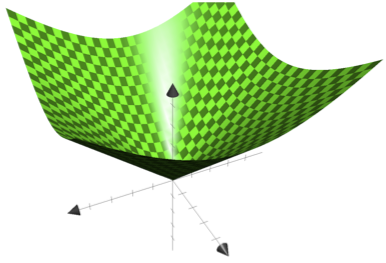
Example G. Generalizing a construction we have seen in the July 2026 post, the Lorentz cone Ln+1 in Rn+1, where n ≥ 1 is the collection of vectors (t, s1, ···, sn)T such that . See the picture above for the case n=2. It is practical to equate such points with pairs (t, s) where t ∈ R and s ≝ (s1, ···, sn) ∈ Rn, and the latter condition is t ≥ ||s||. The interior of Ln+1 is the collection of pairs (t, s) such that t > ||s||, and is non-empty, so Ln+1 is full-dimensional. We can also obtain the same results by using Lemma E, item 4: writing ei for the standard basis vector of Rn, with a 1 at position i and zeros at all other positions, the vectors (1, e1), …, (1, en) and (1, –e1) form a linear basis of Rn+1 that consists of vectors of Ln+1.
Pointed cones
A proper cone will not only need to be full-dimensional, but also pointed in the following sense.
Definition H (Pointed cone). A cone C in Rn is pointed if and only if the only point x such that x and −x are both in C is the zero vector 0.
More succinctly, C is pointed if and only if C ∩ (–C) = {0}.
If n≥ 1, then Rn itself is a cone in Rn that is not pointed. In general, a cone C in Rn is pointed if and only if it does not contain any line {αx | α ∈ R}, for any non-zero vector x in Rn. The Lorentz cone Ln+1 is pointed: if (t, s) ∈ Ln+1 and (–t, –s) ∈ Ln+1, then t ≥ ||s|| and –t ≥ ||–s|| = ||s||; in particular t ≥ 0 and t ≤ 0, so t=0, and then t ≥ ||s|| implies that s=0, too.
The main value of the notion lies in the following lemma.
Lemma I. Every convex cone C in Rn induces a preordering ≤C on Rn, defined by x ≤C y if and only if y−x ∈ C, which is a partial ordering if and only if C is pointed. In that case, the zero vector 0 is the least element of C.
Proof. We have x–x=0 ∈ C, so ≤C is reflexive. If x ≤C y and y ≤C z, then y−x and z–y are in C, hence their sum is, to, so that x ≤C z. Hence ≤C is a preordering. If x ≤C y and y ≤C y, then y−x and x–y are in C, so if C is pointed then they are both equal to 0, namely x=y: ≤C is a partial ordering. Conversely, if ≤C is a partial ordering, then for every point x such that both x and –x are in C, we have 0 ≤C x and x ≤C 0, hence x=0, so C is pointed. Finally, since 0 ≤C x for every x ∈ C, 0 is the least element of C. ☐
Dual cones
For any two vectors z ≝ (z1, …, zn)T and x ≝ (x1, …, xn)T in Rn, we will often have to compute zT x: this is equal to ∑i=1n zi xi, and this is the scalar product of z and x. This scalar product is usually written as z · x or as ⟨z, x⟩, but we will simply use the notation zT x. We also note that zT x = xT z, and that, being just a real number, zT x is its own transpose.
Definition J (Dual cone). The dual cone C* of a cone C in Rn is {z ∈ Rn |∀x ∈ C, zT x ≥ 0}.
Lemma K. For every convex cone C in Rn, its dual cone C* is a closed convex cone.
Proof. The fact that C* is a convex cone is clear. It is closed because it is the intersection of the sets fx−1 ([0, ∞[) over all x ∈ C, where fx is the map z ↦ zT x; fx is linear on a finite-dimensional space, hence is continuous, so fx−1 ([0, ∞[) is closed for every x ∈ C. ☐
Example L. The Lorentz cone (see Example G) is its own dual: (Ln+1)* = Ln+1. Indeed, let (t, s), (t’, s’) ∈ Ln+1. Then (t, s)T (t’, s’) = tt′ + sT s′ ≥ ||s|| ||s′||+ sT s′. The Cauchy-Schwarz inequality, applied to –s and s’, states that (−s)T s′ ≤ ||−s|| ||s′|| = ||s|| ||s′||, so ||s|| ||s′||+ sT s′ ≥ 0. Therefore (t, s)T (t’, s’) ≥ 0. This shows that Ln+1 ⊆ (Ln+1)*.
Conversely, let (t, s) ∈ (Ln+1)* . The vector (1,0) is in Ln+1, so (t, s)T (1,0) ≥ 0, whence t ≥ 0. In particular, (t, s) is in Ln+1 in the special case where s = 0. We now assume s ≠ 0, so that ||s|| ≠ 0. The vector (||s||, –s) is in Ln+1, so (t, s)T (||s||, –s) ≥0. In other words, t ||s|| ≥ sT s′ = ||s||2. Dividing out by ||s||, we obtain that t ≥ ||s||, so (t, s) ∈ Ln+1.
Not every convex cone C in Rn is its own dual: by Lemma K, C* is always closed, so a non-closed cone C in Rn cannot be its own dual. An example of such a cone is the set {(x, y) ∈ R+2 | x = y = 0 or x, y > 0}, which is a convex cone, which is not closed: the points (1, 1/2n) form a sequence of points in the cone that converges to (1, 0), which is not in the cone.
We will need the following result, which is a baby version of classical separation results, and which usually follows from the Hahn-Banach theorem.
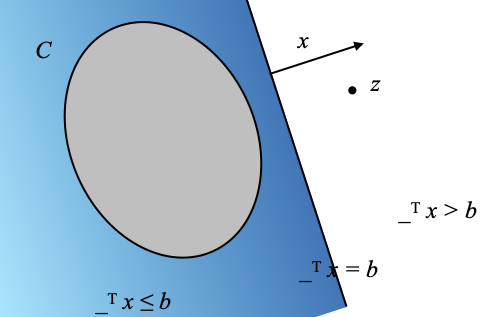
Lemma M (Separation). Let C be a non-empty closed, convex subset of Rn and z ∈ Rn – C. Then there is a vector x ∈ Rn and a real number b such that zT x > b and yT x ≤ b for every y ∈ C.
If C is a closed convex cone in Rn, then we can even require b = 0.
The vector x and the number b define a hyperplane {y ∈ Rn | yT x = b}. The lemma states that one can choose them in such a way that z be on one side of the hyperplane (and outside of it) and the whole of C lies on the other side (possibly touching it), see the picture below.
Proof. Let us remark that for every point y ∈ Rn, ||y|| = . We will use this below.
Let f : Rn → R map every y ∈ Rn to ||z−y||. Since C is non-empty, let us pick an element x0 ∈ C. We let a ≝ inf {f (x) | x ∈ C} ≤ f (x0). Then a is also equal to inf {f (x) | x ∈ C0}, where C0 ≝ {x ∈ C | ||x|| ≤ ||x0||}. Since ||_|| is continuous, C0 is closed. It is bounded, hence compact by Remark A. Since ||_|| is continuous, so is f, so f reaches its infimum at some point y0 of C0 (hence in C): ||z−y0||= a. In other words, y0 is the closest point to z in C, or one of the closest. See the picture below.
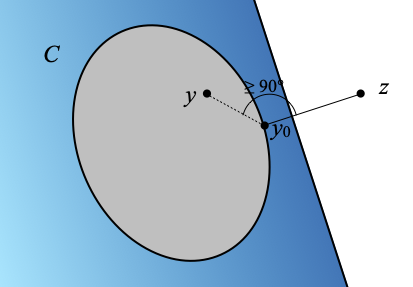
Since z ∉ C, we must have ||z−y0|| > 0, so a >0.
We claim that (z−y0)T (y−y0) ≤ 0 for every y ∈ C. Geometrically, this means that the angle between the segments [z, y0] and [y, y0] is larger than 90 degrees. In order to see this, we realize that, since C is convex, αy + (1−α)y0 is in C for every α ∈]0,1]. Since a realizes the minimum of f on C, a ≤ f (αy + (1−α)y0), in other words, a ≤ ||z − (αy + (1−α)y0)||= ||(z−y0) − α(y−y0)||. Squaring both sides, we obtain that ||z−y0||2 ≤ ((z−y0)−α(y−y0))T ((z−y0)−α(y−y0)) = ||z−y0||2 + α2||y−y0||2 − 2α(z−y0)T (y−y0). Therefore 2α(z−y0)T (y−y0) ≤ α2||y−y0|2. This holds for α>0 (and ≤1), so (z−y0)T (y−y0) ≤ α/2 ||y−y0||2. Letting α tend to 0, we obtain that (z−y0)T (y−y0) ≤0.
Let x ≝ z−y0. The inequality we have just proved rewrites as xT (y−y0) ≤ 0, for every y ∈ C. Let b ≝ xT y0. For every y ∈ C, yT x = xT y is then less than or equal to xT y0 = b. Finally, zT x − b = xT z − xT y0 = xT x = ||x||2 is non-negative. It is non-zero, otherwise x would be equal to 0, so z would be equal to y0, which is impossible since z ∉ C and y0 ∈ C. Therefore zT x − b > 0, namely zT x > b.
Finally, let us assume that C is a closed convex cone. Since 0 ∈ C, the inequality yT x ≤ b for every y ∈ C implies that b ≥ 0. If there was any y ∈ C such that yT x > 0, then, letting α ∈ R+ be so large that α yT x > b, we would obtain a contradiction from the fact that αy ∈ C, hence (αy)T x ≤ b. Therefore yT x ≤0 for every y ∈ C. Since zT x > b ≥0, in particular zT x > 0. Hence we can replace b by 0 in the inequalities zT x > b and yT x ≤ b (y ∈ C). ☐
Proposition N. Let C be a cone in Rn. The bidual cone C** contains C, and is equal to it if C is closed and convex.
Proof. For every x ∈ C, for every z ∈ C*, xT z = zT x ≥ 0, so x ∈ C**. Conversely, let us assume that C is a closed convex cone. If C is a proper subset of C**, then there is a point z ∈ C** that is not in C. By the last part of Lemma M, there is a vector x ∈ Rn such that zT x > 0 and yT x ≤ 0 for every y ∈ C. In particular, yT (−x) ≥ 0 for every y ∈ C, so −x ∈ C*, by definition of C*. Since z ∈ C**, we must have zT (−x) ≥ 0, but this is impossible since zT x >0. ☐
Proposition O. Let C be a cone in Rn. Then C* is a closed convex cone in Rn, which is pointed if C is full-dimensional, and full-dimensional if C is pointed, closed and convex.
Proof. If C is full-dimensional, let x1, . . . , xn be a basis of Rn consisting of elements of C, using Lemma E, item 4. Let z ∈ C* be such that −z is also in C*. For every i ∈ {1, ···, n}, zT xi ≥0 and (−z)T xi ≥0, so zT xi = 0. Since x1, . . . , xn is a basis of Rn, zT x = 0 for every x ∈ Rn. Taking x equal to the standard basis vector ei, this entails that the ith component of z is equal to 0. This holds for every i ∈{1, ···, n}, so z = 0. Hence C* is pointed.
If C is pointed, closed and convex, we claim that C* is full-dimensional. Let us assume that C* is not full-dimensional. C*−C* is a linear subspace of Rn, as one sees easily, and one that is different from Rn by Lemma E, item 2. Hence a basis z1, . . . , zm of C*−C* must consist of strictly less than n vectors. Because of this, there must be a non-zero vector x ∈ Rn such that ziT x = 0 for every i ∈ {1, ···, m}: in order to find one, we need to solve a system of m < n equations in n variables, and such a system has at least n−m independent solutions. From ziT x = 0 for every i ∈ {1, ···, m}, we deduce that zT x = 0 for every z ∈ C*−C*. Hence xT z = zT x ≥ 0 (indeed, is equal to 0) for every z ∈ C*, and also (–x)T z = zT (–x) ≥ 0 (indeed, again equal to 0) for every z ∈ C*. This shows that both x and −x are in C**. Since C is closed and convex, we have C** = C by Proposition N, so x and −x are both in C. This is impossible since C is pointed. ☐
Proper cones
Have you forgotten what we were at? I guess so. We were trying to define proper cones, and we are there at last.
Definition P (Proper cone). A proper cone in Rn is a pointed full-dimensional closed convex cone in Rn.
By Proposition O and Proposition N, for every proper cone C in Rn, C* is also a proper cone in Rn, and C** = C. We sum this up in the following proposition, together with some information we will need later on. We will also reuse the notations z0, x0, C1 and C*1 in at least two occasions, so try to keep them in mind.
Proposition Q. For every proper cone C in Rn, C* is also a proper cone in Rn, and C** = C.
For every z0 ∈ int(C*) (and such a point exists), the set C1 ≝ {x ∈ C | z0T x = 1} is compact, and if n≥1, then C1 is non-empty and every element of C can be written as αx for some x ∈ C1 and α ∈ R+.
For every x0 ∈ int(C) (and such a point exists), the set C*1 ≝ {z ∈ C* | zT x0 = 1} is compact, and if n≥1, then C*1 is non-empty and every element of C* can be written as αz for some z ∈ C*1 and α ∈ R+.
Proof. We have already argued that the first part is by Proposition O and Proposition N. Let us turn to the second part.
Since C* is proper, int(C*) is non-empty. We fix an arbitrary point z0 ∈ int(C*), and we let C1 ≝ {x ∈ C | z0T x = 1}. This is the intersection of the closed set C with the inverse image of the closed set {1} under the (linear hence) continuous map x ↦ z0T x, hence is closed.
If n=0, then C, C* and Rn are reduced to one point, and so are their interiors. Then C1 and C1* are empty, and therefore compact. We now assume n≥1.
Since C is closed, the set C’1 ≝ {x ∈ C | ||x||= 1} is closed and bounded, hence compact by Remark A. C cannot be reduced to {0}, since its interior would be empty, considering that n≥1. Hence there is a non-zero element u in C, and then u1 ≝ u/||u|| is in C’1. showing that C’1 is non-empty. Since x ↦ z0T x is continuous, it maps C’1 to a compact set of real numbers, which is non-empty since C’1 is non-empty. In particular, there is a point x0 ∈C’1 such that z0T x0 = infx∈C’1 z0T x, namely, the infimum is attained. Let a be this infimum. Since z0 ∈int(C*), z0−ϵx0 is still in int(C*), hence in C*, for ϵ > 0 small enough. By definition of C*, and since x0 ∈ C’1 ⊆ C, this entails that (z0−ϵx0)T x0 ≥0, hence that a = z0T x0 ≥ ϵ ||x0||2 = ϵ. Therefore a > 0.
For every element x ∈ C1, x is not equal to zero since z0T x = 1. Therefore x/||x|| is well-defined, and in C’1. By definition of a, z0T (x/||x||) ≥ a, so ||x|| ≤ 1/a. This implies that the closed set C1 is bounded, hence compact by Remark A.
For every element y of C, z0T y ≥ 0 since z0 ∈ C*. If z0T y > 0, then y can be written as αx where α ≝ z0T y and x ≝ (1/α)y ∈ C1. If z0T y = 0, then we can write y as αx where α ≝ 0 and x is any point of C1. Such a point exists: take (1/a)x0, for example. In particular, we have shown that C1 is non-empty.
We reason similarly in order to establish the final part of the Proposition, swapping C and C* (thanks to the fact that C** = C) and x0 and z0. ☐
The cross-dual matrix cone RC,C* and the cone Γ(C)
The special case of a crossed matrix cone RC,C′ where C′ = C* is called a cross-dual matrix cone. Every matrix M ∈ RC,C* is in the cone Γ(C) of matrices that preserve C, in the sense that the associated linear operator maps vectors of C to vectors of C, as item 2 of the following lemma shows, among other things.
One may legitimately ask whether RC,C* = Γ(C), and item 3 gives a partial answer; we will give a fuller answer in Theorem Zc, the final theorem of this post.
Lemma R. Let C be a convex cone in Rn, and Γ(C) denote the set of matrices M ∈ Mn that preserve C, in the sense that Mu ∈ C for every u ∈ C. Then:
- Γ(C) is a convex cone, which is closed if C is closed;
- RC,C* ⊆ Γ(C);
- If C = R+n, the cone of vectors with non-negative entries, then Γ(C) = RC,C*, and is the cone of matrices with non-negative entires, which we may equate with R+n2.
Proof. 1. That Γ(C) is a convex cone is easy. If C is closed, then Γ(C) is closed because it is equal to ∩u∈C fu−1 (C), where fu : M ↦ Mu is linear hence continuous for every u ∈ C.
2. Let M ≝ ∑i=1m ui viT be an arbitrary element of RC,C*, where m ∈ N and ui ∈ C, vi ∈ C*. For every u ∈ C, Mu = ∑i=1m ui viT u = ∑i=1m (viT u) ui is in C. Therefore M ∈ Γ(C).
3. Let C ≝ R+n. Then C* is the collection of vectors u ∈ Rn such that uT v ≥ 0 for every v ∈ Rn. This holds in particular for v equal to the standard basis vector ei, so every element u ≝ (u1, …, un)T of C* must satisfy ui ≥ 0 for every i ∈{1, ···, n}. That is, C* ⊆ C. Conversely, for every u ∈ C, we have uT v ≥ 0 for every v ∈ Rn, since uT v is a sum of products of non-negative numbers. Hence C ⊆ C*. We conclude that C* = C = R+n.
In particular, RC,C* = RC,C, which consists of matrices of the form ∑i=1m ui viT where ui, vi ∈ R+n. Any such matrix has non-negative entries. Conversely, for every matrix A ∈ Mn with non-negative entries aij, 1 ≤ i, j ≤ n, we can write A as ∑i,j=1n aij ei ejT, namely as ∑i,j=1n (aij ei) ejT, showing that A is in RC,C*. ☐
The following is a special case of Theorem 3.1 (i) of [3], and gives another relation between Γ(C) and cross-dual matrix cones. Equating matrices A, B in Mn with vectors uA, uB in Rn2, there is a funny way of computing the scalar product uAT uB, as Tr (ABT). (The operator Tr is the trace operator, which computes the sum of the diagonal entries.) Indeed, if A = (aij)1 ≤ i, j ≤ n and B = (bij)1 ≤ i, j ≤ n, then ABT is the matrix whose i,j-entry is ∑k=1n aik bjk, so its trace is ∑i,k=1n aik bik, and that is exactly uAT uB. Using this formula is sometimes helpful, especially once we are aware of the following three facts: for every real number a, seen as a 1 × 1 matrix, Tr (a)=a; for all matrices A and B of respective dimensions m × n and n × m, Tr (AB) = Tr (BA); and Tr is linear.
Lemma S. For every closed convex cone C in Rn, Γ(C)= RC*,C*.
Proof. For every A ∈ RC*,C*, by definition Tr (ABT) ≥ 0 for every B ∈ RC*,C, in particular when B = u vT where u ∈ C* and v ∈ C. Then Tr (ABT)= Tr (AvuT)= Tr (uTAv) = uTAv (a 1 × 1 matrix) = (Av)T u. This holds for every u ∈ C*, so Av ∈ C**. Since C is closed, C** = C by Proposition N, so Av ∈ C. This holds for every v ∈ C, so A ∈ Γ(C).
Conversely, let A ∈ Γ(C). For all u ∈ C* and v ∈ C, and letting B ≝ u vT, Tr (ABT)= Tr (AvuT) = uTAv = uT(Av) ≥0, since u ∈ C* and Av ∈ C. Since Tr is linear, the same inequality holds for every sum of terms u vT, namely for every element B of RC*,C, so A ∈ RC*,C*. ☐
Carathéodory’s theorem
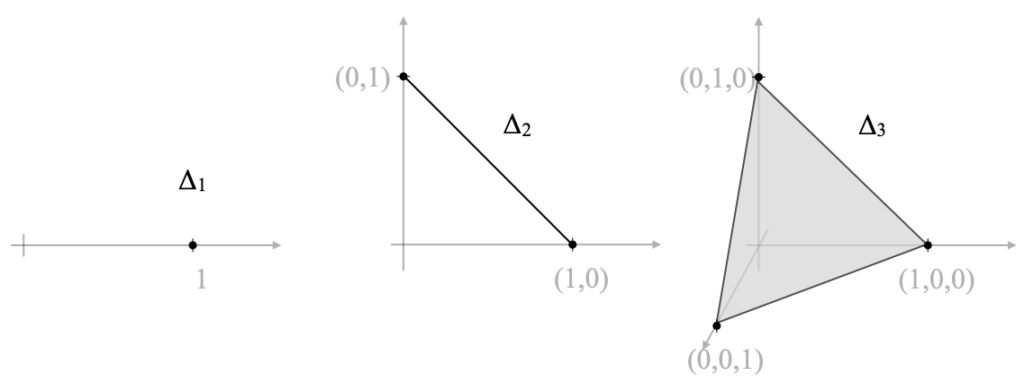
It will be practical to introduce the notion of standard simplices. For every n≥ 1, let ∆n be the set of vectors of n non-negative real numbers α ≝ (α1, α2, ···, αn)T such that that ∑i=1n αi = 1. See the following picture for the cases n=1, 2, 3.
A word of warning, though: ∆n is usually denoted as ∆n–1, and called the standard (n−1)-simplex, in the algebraic topology literature.
We will need the following important observation, due to Constantin Carathéodory. We already mentioned this result in the July 2026 post, and we give a proof of it here.
Proposition T (Carathéodory’s theorem). For every n ∈ N, for every subset A of Rn, every point of the form ∑i=1m αi xi with m≥1, (α1, α2, ···, αm)T ∈ ∆m and xi ∈ A for every i ∈{1, ···, m} can be written in the same way, with the additional constraint that m ≤ n + 1.
The collection of elements of the form ∑i=1m αi xi as above is the convex hull of A, namely the smallest convex subset of Rn that contains A. Carathéodory’s theorem states that every point in the convex hull of a subset A of Rn, however large, is already in the convex hull of at most n+1 points of A.
Proof. Let x be any point in the convex hull of A, and let us write x as ∑i=1m αi xi, where m≥1, (α1, α2, ···, αm)T ∈ ∆m and xi ∈ A for every i ∈{1, ···, m}, in such a way that m is minimal. We claim that m≤n+1, and to see this, we assume that m>n+1 and we reach for a contradiction. Since m>n+1, the vectors x2−x1, x3−x2, . . . , xm−xm–1 form a list of strictly more than n vectors in Rn, so they must be linearly dependent. In other words, there are real coefficients β1, ···, βm–1, not all equal to 0, such that ∑i=1m–1 βi (xi+1−xi) = 0. We rewrite this as ∑i=1m γi xi = 0, where γ1 ≝ –β1, γi ≝ βi–1 – βi for every i ∈{2, ···, m−1} and γm ≝ βm–1. We note that ∑i=1m γi = 0. The latter implies that at least one number γi is strictly positive (in particular, non-zero): otherwise, β1 = −γ1 ≥0, β2 = β1−γ2 ≥ β1, . . . , βm−1 = βm−2 −γm−1 ≥ βm−2, and finally βm−1 = γm−1 ≤0, so we would have 0 ≤ β1 ≤ β2 ≤ ··· ≤ βm−1 ≤0, which would entail that every βi is equal to 0.
For every t ∈ R, we have x = ∑i=1m αi xi – t ∑i=1m γi xi (since ∑i=1m γi xi = 0) = ∑i=1m (αi – t γi) xi. We will fix t shortly. The set I of indices i ∈ {1, ···, m} such that γi > 0 is finite and, as we have seen, non-empty. Therefore it makes sense to let t ≝ mini∈I (αi/γi). Let i0 ∈ I be such that t = αi0/γi0. Since every αi is in R+ and since i0 ∈ I, hence γi0 > 0, we note that t ≥ 0. In the sum ∑i=1m (αi – t γi) xi, the term with i=i0 is equal to 0; the terms with i ∈ I–{i0} are such that t ≤ αi/γi by definition of t as a minimum, so αi – t γi ≥0; the terms with i ∉ I are such that αi – t γi ≥ αi (since t ≥ 0 and γi ≤ 0) ≥ 0 (since αi ∈ R+). It follows that x is equal to the sum of (αi – t γi) xi over all i ∈ {1, ···, m}–{i0}, a sum of at most m−1 vectors xi from A multiplied by non-negative coefficients. Additionally, the sum of these coefficients is equal to ∑i=1m (αi – t γi) (since the coefficient obtained with i=i0 is equal to 0) = ∑i=1m αi – t ∑i=1m γi = ∑i=1m αi (since ∑i=1m γi = 0) = 1, so the vector of these coefficients is in ∆m–1. This contradicts the minimality of m, proving the theorem. ☐
The cross-dual matrix cone of a proper cone is closed
We arrive at the promised result that RC,C′ is a closed convex cone “under some conditions”, as we said earlier. The precise result is that this holds if C’ = C* and C is a proper cone. We had proved this in the special case where C is the 3-dimensional Lorentz cone L3 in the July 2026 post (see Proposition 4.1 there), considering that the cone RC studied there is RC,C, and that the Lorentz cone is its own dual (see Example L).
We equip the standard simplex ∆n with the subspace topology from Rn. As such, this is a compact Hausdorff space.
Theorem U. For every proper cone C in Rn, the cross-dual matrix cone RC,C* is closed in Mn ≅ Rn2.
Proof. If n=0, this is clear, since RC,C* contains just the zero matrix. We therefore assume n≥1.
Let z0, x0, C1 and C*1 be defined as in Proposition Q. Let us say that an element of RC,C* is normalized if and only if it is of the form ∑i=1m αi ui viT where m=n2+1, (α1, α2, ···, αm)T is in ∆m, each ui is in C1 and each vi is in C*1. Let us write R1C,C* for the set of normalized elements of RC,C*.
We observe that R1C,C* is compact in Mn. Indeed, let f : ∆m × Cm ×(C*)m → Mn map ((α1, ···, αm)T,(u1, ···, um), (v1, ···, vm)) to ∑i=1m αi ui viT. The function f is continuous, since composing it with each projection onto coordinates j, k yields the continuous map ((α1, ···, αm)T,(u1, ···, um), (v1, ···, vm)) ↦ ∑i=1m αi uij vikT (writing the jth component of ui as uij and the kth component of vi as vik). ∆m is compact, and so are C1 and C*1 by Proposition Q, so ∆m × C1m ×(C*1)m is compact. Therefore R1C,C* = f [∆m × C1m ×(C*1)m] is compact.
We also note that every element w ≝ ∑i=1m ui viT of RC,C* (with m≥1 arbitrary, ui ∈ C and vi ∈ C*) is equal to αw1 for some α ∈ R+ and some w1 ∈ R1C,C*; we will call αw1 the standard form of w. Indeed, first, by Carathéodory’s theorem (Proposition T) we can require m≤n2+1. We can in fact require that m=n2+1, by adding dummy zero terms. By Proposition Q, we can write each ui as βi u1i and each vi as γi v1i, where βi, γi ≥ 0, u1i ∈ C1 and v1i ∈ C*1. Therefore w =∑i=1m βi γi u1i (v1i)T. Let α ≝ ∑i=1m βi γi. If α = 0, then we can take any element of R1C,C* for w1. Such an elements exists: by Proposition Q, C1 and C*1 are non-empty, then take w1 ≝ u vT where u ∈ C1 and v ∈ C*1. If α > 0, then w = αw1 where w1 ≝ ∑i=1m (βi γi / α) u1i (v1i)T. Now (β1 γ1 / α, …, βm γm / α) is in ∆m, so w1 ∈ R1C,C*.
We can now prove that RC,C* is closed. Since Rn2 is a metric space, it suffices to show that the limit of every convergent sequence of elements of RC,C* is in RC,C*. Let therefore (αnwn)n∈N be a sequence of elements of RC,C*, all written in standard form, and let us assume that it converges to some element w∞ of Mn ≅ Rn2. If w∞= 0, then w∞ is in RC,C*, and we conclude. Hence we assume that w∞≠0 from now on.
Since R1C,C* is compact, there is a subsequence (wnk)k∈N of (wn)n∈N (with n1 < … < nk < …) that converges to some element w of R1C,C*. Additionally, (αnkwnk)k∈N still converges to w∞. Since w∞≠0, we have wnk≠0 for infinitely many values of k; otherwise wnk would be equal to 0 for k large enough, and this would imply w∞= 0. Hence, extracting a further subsequence if necessary, we may assume that wnk≠0 for every k ∈ N. Since Euclidean norm ||_|| is continuous, the terms ||αnkwnk||= αnk ||wnk|| converge to ||w∞||. Since division is continuous on R–{0} with its usual metric topology, the scalars αnk = ||αnkwnk||/||wnk|| converge to α ≝ ||w∞||/||w||. This makes sense since w is in R1C,C*, hence is non-zero, so that ||w||≠0. Now the scalars αnk converge to α, the matrices wnk converge to w, so the matrices αnkwnk converge to αw. In a Hausdorff space such as Rn2, limits are unique, so w∞= αw. We have α ∈ R+ and w ∈ R1C,C*, so w∞ is in RC,C*. ☐
Simplicial cones, extreme rays
We will now embark on characterizing when the identity matrix is in the cross-dual matrix cone RC,C*. The answer rests on the notion of simplicial cones, defined as follows.
Definition V (Polyhedral, simplicial cones). A cone C in Rn is polyhedral if and only if it is generated by finitely many vectors x1, . . . , xm ∈ Rn, in the sense that C = {∑i=1m αi xi | α1, . . . , αm ∈ R+}. It is simplicial if and only if, in addition, the vectors x1, . . . , xm can be taken to form a linear basis of Rn (in particular, m=n).
Every polyhedral cone is closed and convex, every simplicial cone is polyhedral. A line {αx |α ∈ R}, where x≠0, is polyhedral since it is generated by x and −x, but is not simplicial.
Definition W. Given a convex cone C in Rn, an extreme ray of C is a ray Rx, for some x ∈ C–{0}, such that if we can write x as a sum u + v with u, v ∈ C, then both u and v must be in Rx.
A typical example of extreme rays is given by the rays Rx1, . . . , Rxn of a simplicial cone in Rn, as we will illustrate in Lemma X below. Before that, let us notice that the notion of extreme ray only depends on the ray Rx itself, not on the particular element x. Indeed, let us assume that Rx = Ry for two non-zero vectors x and y. Then y = αx for some α>0. Let us assume that x is such that the only way to write x as u + v with u, v ∈ C is to take u, v ∈ Rx. Then, if we can write y as u′ + v′ with u’, v’ ∈ C, we will have x = u + v where u ≝ (1/α)u′ and v ≝ (1/α)v′, both of them in C; so u, v ∈ Rx = Ry, and therefore u′, v′ ∈ Ry as well.
We will see that a polyhedral cone can only have finitely many extreme rays. Some convex cones have infinitely many. For example, the extreme rays of the Lorentz cone Ln+1 (with n≥1) are the rays R(1,s) where s ranges over the unit sphere of Rn, namely the set of vectors s of Rn such that ||s||= 1, and there infinitely many, in fact uncountably many. I will leave this as an exercise. As hints, you should first show that every ray of Ln+1 can be written as R(1,s) where 0 < ||s|| ≤ 1. In order to show that this is not an extreme ray if ||s||<1, write s as the sum of (1/2, (1+ϵ)/2 s) and of (1/2, (1−ϵ)/2 s) for ϵ > 0 small enough. When ||s||=1, imagine that (1, s) is the sum of two elements (t1, s1) and (t2, s2) of Ln+1, show that t1 = ||s1|| and t2 = ||s2||, then use the (full) Cauchy-Schwarz inequality: s1T s2 ≤ ||s1|| ||s2||, with equality if and only if s1 and s2 are linearly dependent, with positive coefficients (i.e., s1=0 or s2=0 or s2 = λ s1 for some λ>0).
At the other end of the spectrum, some convex cones, even some non-trivial convex cones (i.e., some convex cones that are different from {0}) have no extreme ray at all. For example, taking C ≝ R2 as a convex cone in R2, every non-zero vector x ≝ (x1, x2) ∈C can be written as the sum of 1/2 (x1−x2, x1+x2) and of 1/2 (x1+x2, x2−x1) , which are both in C, but neither of them is in Rx; in fact neither of them is even a scalar multiple of x. Therefore no ray of C is extreme.
Lemma X. Let C be a polyhedral cone in Rn, generated by a family of vectors x1, . . . , xm. The extreme rays of C are among Rx1, . . . , Rxm. If the vectors x1, . . . , xm are linearly independent, then the extreme rays are exactly Rx1, . . . , Rxm.
Proof. Let Rx be an extreme ray of C, where x ∈ C–{0}. We write x as ∑i=1m αi xi, where each αi is in R+. We pick i so that αi > 0; this must exist, otherwise x would be equal to 0. Since x = αi xi + ∑j≠i αj xj and Rx is extreme, αi xi is in Rx, so xi ∈ Rx, and hence Rx = Rxi.
We now assume that x1, . . . , xm are linearly independent. Let i ∈{1, ···, m}, and let us assume that we can write xi as u + v with u, v ∈ C . Since x1, . . . , xm generate C, we can write u as ∑i=1m αi xi and v as ∑i=1m βi xi where αi, βi ≥ 0. From xi = u + v and the fact that the vectors x1, . . . , xm are linearly independent, we obtain that 1 = αi + βi and αj + βj = 0 for every j≠i. Since αj, βj ≥0, we must have αj = βj = 0 for every j≠i. Therefore u = αi xi and v = βi xi are in Rxi. This shows that Rxi is an extreme ray of C. ☐
Lemma X implies that a polyhedral cone can only have finitely many rays. We have seen that the Lorentz cone Ln+1 (with n≥1) has uncountably many, hence Ln+1 is not polyhedral.
Lemma Y. Given a pointed polyhedral cone C in Rn, generated by vectors x1, . . . , xm, C is already generated by those vectors xi such that Rxi is an extreme ray of C.
Proof. Let C be generated by vectors x1, . . . , xm, with m ∈ N. By Lemma X, all the extreme rays of C are among Rx1, . . . , Rxm. Up to permutation, we will assume that they are those numbered from 1 to p, where 0 ≤ p ≤ m.
For all i, j ∈{1, ···, m}, let us write i ◁ j if and only if xj is in the cone generated by x1, . . . , xi, namely if xj can be written as a linear combination of x1, . . . , xi with non-negative coefficients. Clearly, i ◁ i for every i ∈{1, ···, m}. We claim that: (∗) if i ◁ i+1 ◁ ··· ◁ j, then i ◁ j. This is by induction on j−i. The case j−i=0 is trivial. Otherwise, xj can be written as ∑k=1j–1 αk xk where each αk is in R+, since j−1 ◁ j. By induction hypothesis, for every k ∈ {i + 1, ···, j−1} we have i ◁ k, so we can write xk as ∑l=1i βkl xl where each βkl is in R+. Therefore xj = ∑l=1i (∑k=1j–1 αk βkl) xl, so i ◁ j.
We claim that k ◁ k+1 ◁ ··· ◁ m for every k ∈ {p, ···, m}. We prove this by induction on m−k. If m−k=0, this is clear. Otherwise, we show that k ◁ k+1 under the induction hypothesis k+1 ◁ k + 2 ◁ ··· ◁ m, where p ≤ k < m. Using the induction hypothesis and (∗), we have k+1 ◁ k+2, k+1 ◁ k+3, . . . , k+1 ◁ m, so xk+2, . . . , xm can all be written as linear combinations of x1, . . . , xk+1 with non-negative coefficients. It follows that every element of C, which is a linear combination of x1, . . . , xm with non-negative coefficients, can be rewritten as a linear combination of x1, . . . , xk+1 instead, still with non-negative coefficients. Since p ≤ k < m, Rxk+1 is not an extreme ray of C. Therefore we can write xk+1 as u + v where u, v ∈ C, and u or v is not in Rxk+1. By symmetry, let us assume that v ∉ Rxk+1. We can write u and v as linear combinations of x1, . . . , xk+1, with non-negative coefficients, as we have seen above. Hence let us write u as ∑i=1k+1 αi xi and v as ∑i=1k+1 βi xi, where αi, βi ∈ R+. We then have xk+1 =∑i=1k+1 (αi+βi) xi. If αk+1+βk+1 ≥ 1, then (1–αk+1–βk+1) xk+1 is in –C, and is equal to ∑i=1k (αi+βi) xi, which is in C. Since C is pointed, both are equal to 0. In particular, ∑i=1k (αi+βi) xi = 0. The latter implies that ∑i=1k αi xi, which is in C, is equal to –∑i=1k βi xi, which is in –C. Since C is pointed, both are equal to 0. Therefore v = ∑i=1k+1 βi xi = βk+1 xk+1 is in Rxk+1, and that is impossible. Hence we must conclude that αk+1+βk+1 <1, and therefore xk+1 =∑i=1k xi, so k ◁ k+1.
Now that we know that k ◁ k+1 ◁ ··· ◁ m for every k ∈ {p, ···, m}, we have p ◁ p+1 ◁ ··· ◁ m, so p ◁ l for every l ∈ {p+1, ···, m} by (*). In other words, every xl with l ∈ {p+1, ···, m} can be expressed as a linear combination of x1, . . . , xp with non-negative coefficients. Since every element x of C can be expressed as a linear combination of x1, . . . , xp, xp+1, . . . , xm with non-negative coefficients, we can rewrite that linear combination as a linear combination of x1, . . . , xp alone, still with non-negative coefficients. ☐
The only if direction of the following theorem appears as Lemma 5.1 of [4], and is the only direction that we will be interested in future posts. Both directions were proved by Barker and Loewy [2, Proposition 3.1], see also the survey [1, Theorem 2.B.5]. Barker and Loewy actually consider the case where C is not necessarily proper, in which case RC,C* must be replaced by its closure.
Theorem Z. Let C be a proper cone in Rn. The identity matrix In is in the cross-dual matrix cone RC,C* if and only if C is simplicial.
Before we prove this, let us take the example of the Lorentz cone Ln+1, with n≥1. We have seen that Ln+1 is not polyhedral, hence certainly not simplicial. This implies that, when C ≝ Ln+1, RC,C* cannot contain the identity matrix. We have seen in Example L that C ≝ Ln+1 is its own dual, so RC,C = RC,C* cannot contain the identity matrix. This is what we proved near the end of the July 2026 post, in the special case n=2.
Proof. If C is simplicial, then it is generated by a linear basis x1, . . . , xn of Rn. Let A be the matrix obtained by putting x1, . . . , xn side by side, as its columns. Since x1, . . . , xn form a linear basis, A is invertible. We can write In as AInA−1, and rewrite the middle In as ∑i=1n ei eiT, so In = ∑i=1n A ei eiT A−1. But A ei = xi is in C, and (eiT A−1)T is in C*, since for every j ∈{1, ···, n}, (eiT A−1)TT xj = eiT A−1 xj = eiT ej, which is equal to 1 if i=j and to 0 otherwise, and is therefore non-negative in any case. In other words, In = ∑i=1n ui viT where ui ≝ A ei ∈ C and vi ≝ (eiT A−1)T ∈ C*, showing that In ∈ RC,C*.
We now assume that C is a proper cone such that In ∈ RC,C*, and we aim to show that C is simplicial. We reuse z0, x0, C1 and C*1 from Proposition Q. Since In ∈ RC,C*, we can write In as ∑i=1m ui viT where m≥1, ui ∈ C and vi ∈ C*. Without loss of generality, we will assume that no ui and no vi is equal to 0. We can also assume that Rui≠Ruj for all i≠j: otherwise uj=βui for some β>0, and we can rewrite ui viT + uj vjT as ui (vi + βvj)T.
We can write each ui as αi u’i for some αi ∈ R+ and u’i ∈ C1. We have an explicit formula for αi: since u’i ∈ C1, by definition of C1, z0T u’i = 1, so z0T ui = αi. No αi is equal to 0, and we can write ui viT as u’i v’iT, where v’i ≝ αi vi. Hence In = ∑i=1m u’i v’iT, where each u’i is in C1. Additionally, the rays Ru’i are pairwise distinct, because Ru’i=Rui.
For every x1 ∈ C1, x1 = In x1 = ∑i=1m u’i v’iT x1 = ∑i=1m (v’iT x1) u’i. We note that the coefficients v’iT x1 are non-negative, since v’i ∈ C* and x1 ∈ C. Their sum ∑i=1m (v’iT x1) is equal to (∑i=1m v’iT) x1. But v’iT = αi viT = z0T ui viT, so ∑i=1m v’iT = z0T ∑i=1m ui viT = z0T In = z0T. Therefore ∑i=1m (v’iT x1) = z0T x1, which is equal to 1 since x1 ∈ C1. Hence (v’1T x1, ···, v’mT x1) is in ∆m. We have shown that every element x1 ∈ C1 can be written as ∑i=1m βi u’i, for some (β1, ···, βm) ∈ ∆m, namely βi ≝ v’iT x1.
Every element x of C can be written as αx1 for some α ∈ R+ and x1 ∈ C1. Then x = ∑i=1m αβi u’i. This shows that C is polyhedral. It is pointed since proper, so by Lemma Y, C is generated by those vectors u’i such that Ru’i is an extreme ray of C. Up to permutation, we will assume that these vectors are numbered u’1, . . . , u’p.
For every j ∈ {1, ··· , p}, u’j is in C1, hence can be written as ∑i=1m βi u’i for some (β1, ···, βm) ∈ ∆m. We have in fact seen that we can take βk ≝ v’kT u’j for every k ∈ {1, ···, m}. For every k ∈ {1, ···, m}–{j}, we can split the sum ∑i=1m βi u’i into the sum of βk u’k and of ∑i≠k βi u’i. Since Ru’i is an extreme ray of C, both terms must be in Ru’i, in particular the first one. If βk≠0, this would imply that Ru’i=Ru’k, but we have made sure that the rays Ru’i are pairwise distinct, so this is impossible. It follows that βk=0 for every k ∈ {1, ···, m}–{j}, and then that βj=1, since (β1, ···, βm) ∈ ∆m. In other words, v’kT u’j = 0 for every k ∈ {1, ···, m}–{j}, and v’jT u’j = 1.
Now let us imagine that ∑i=1p αi u’i = 0, for arbitrary real numbers α1, . . . , αp. For every k ∈ {1, ···, p}, we have 0 = v’kT ∑i=1p αi u’i = ∑i=1p αi v’kT u’i = αk, so all the coefficients αk are equal to zero. This shows that the vectors u’i, 1 ≤ i ≤ p, are linearly independent. We remember that C is generated (as a cone) by these vectors. C is proper, hence full-dimensional, hence by Lemma E, every vector of Rn is a linear combination of vectors of C, which are all linear combinations of u’1, . . . , u’p. This shows that these vectors form a linear basis of Rn, hence that C is simplicial. ☐
When does RC,C* = Γ(C) hold?
We finally answer the question in which cases RC,C* = Γ(C). We had given a partial answer to that question in Lemma R, item 3.
For every A ∈ Mn, for every cone K in Rn, we write AK for {AB | B ∈ K}. Similarly, KB = {AB | A ∈ K}. We will apply this notably to the case K ≝ R+n.
Lemma Za. Let A ∈ Mn and K be a cone in Rn. If A is invertible, then (AK)* = (A−1)T K*.
Proof. Since A is invertible, AT is invertible, too, and (AT)−1 = (A−1)T. Indeed, AT (A−1)T = (A−1A)T = InT = In and (A−1)T AT = (AA−1)T = InT = In.
The elements w of (AK)* are those vectors such that wT Au ≥0 for every u ∈ K. Writing w as (AT)−1 v = (A−1)T v, wT Au = vT A−1 Au = vT u, so the elements of (AK)* are the vectors (AT)−1 v such that vT u ≥0 for every u ∈ K. In other words, (AK)* = (A−1)T K*. ☐
Lemma Zb. Let A ∈ Mn and K be a cone in Rn. If A is invertible, then Γ(AK)= A Γ(K) A−1 and RAK,(AK)* = A RK,K* A−1.
Proof. For every matrix M ∈ Mn, M ∈ Γ(AK) if and only if for every u ∈ AK, Mu ∈ AK, if and only if for every v ∈ K, MAv ∈ AK, if and only if for every v ∈ K, A−1 MAv ∈ K, if and only if A−1MA ∈ Γ(K), if and only if M ∈ A Γ(K) A−1.
An element of RAK,(AK)* is a finite sum ∑i=1m A ui wiT where ui ∈ K and wi ∈ (AK)*. By Lemma Za, (AK)* = (A−1)T K*, so the elements of RAK,(AK)* are the finite sums ∑i=1m A ui ((A−1)T vi)T, where ui ∈ K and vi ∈ K*. Such a finite sum is equal to ∑i=1m A ui viT A−1 = A (∑i=1m ui viT) A−1. Therefore RAK,(AK)* = A RK,K* A−1. ☐
Theorem Zc. For a proper cone C in Rn, the following are equivalent:
- RC,C* = Γ(C);
- C is simplicial;
- there is an invertible matrix A ∈ Mn such that C = A R+n.
Proof. 1⇒2. The identity matrix In is in Γ(C), so if RC,C* = Γ(C), then C is simplicial by Theorem Z.
2⇒3. Let us assume that C is simplicial. As in the beginning of the proof of Theorem Z, the matrix A whose columns are any given linear basis x1, . . . , xn that generate C is invertible. The elements of C are the linear combinations ∑i=1n αi xi where u ≝ (α1, ···, αn) ∈ R+n, namely the vectors Au with u ∈ R+n. Hence C = A R+n.
3⇒1. Let us write C as AK, where A is an invertible matrix and K ≝ R+n. Then Γ(C) = Γ(AK)= A Γ(K) A−1 by Lemma Zb, Γ(K) = RK,K* by Lemma R, item 3, so Γ(C) = A RK,K* A−1. The latter is equal to RAK,(AK)*, namely to RC,C* , by Lemma Zb. ☐
- George Phillip Barker. Theory of cones. Linear Algebra and its Applications, 39:263–291, 1981.
- George Phillip Barker and Raphael Loewy. The structure of cones of matrices. Linear Algebra and its Applications, 12(1):87–94, 1975.
- Abraham Berman and Prabha Gaiha. A generalization of irreducible monotonicity. Linear Algebra and its Applications, 5(1):29–38, 1972.
- Yuxu Chen, Hui Kou and Zhenchao Lyu. Characterizing finite posets whose probabilistic powerdomains are RB-domains. Available on arXiv:2607.02231v1 [math.CO], 2026.
- Yuxu Chen, Hui Kou and Zhenchao Lyu. FS-domains are not always RB-domains. Available on 2607.00568v2 [math.GN], 2026.
— Jean Goubault-Larrecq (September 20th, 2026)